Sunday, October 26, 2014

Me, Music and Musings #1

Daily Disclaimer:

Please note that in this installment of BDSM there's going to be extreme metal. But also some damn good jokes*. So, if you already decided to skip this one, reconsider. Please.

***

No worries, no grumpy bullshit this time round. In Me, Music and Musings we're going to tackle all things un-pop and today, for the first time, I'm about to show you some of the most insane music ever created. And you're about to like it, I'm damn sure. Today's weapon of choice is A Forest of Stars. Let's smash some ears with the only psychedelic, steam-powered black metal band in the whole Victorian Empire.


This amazing video clip was created by Ingram Blakelock, a visual artist from the UK. As you could probably see, it's a rather dramatic depiction of friendzoning gone wrong [laugh track]. In order to make the whole story clearer and provide you with a background of sorts, let's have a look at lyrics of the intro track from A Shadowplay for Yesterdays.

Once upon a time there was a lady of no repute,
One Miss Crow, who, by force of a certain stranger,
had engaged in violent night-time actions, against her very will.

Resulting from this invasion came,
an aberration of desperation, a horror in all but name,
A stoop-backed boy, short of stature, violent by nature;
to be expelled from the womb in late November.
A fast track to sorrow in a world bred slow.
From foetid seed, a poison tree with a venomous bark did grow.

He was to work all the hours his sorry god sent,
a resident of fantasy, living a life of lament.
He was to have no living lovers, no-one on who to depend.
Yet his friends were to call him Carrion,
the friends inside his head...

The protagonist of the above mentioned album is the stoop-backed boy whose mother was a prostitute raped by a stranger. He lives is a world of fantasy where he pictures himself being the puppetmaster of all men in the industrial Yonder Town. He obviously can be quite effective in the real world too, as you could certainly see. What's even more important, though, is that the lyrics on this record seem to be way more direct and less obscure compared to the previous albums by the band. Let's give a listen to a track from Opportunistic Thieves of Spring.


Sound's heavier, punchier, rawer and the whole thing leans more towards black metal and doom metal rather than folk. Even though both albums are excellent, one can instantly notice that the band has slightly softened and diversified their sound. I gave a more positive review to the latest album by the band, but I remember reading Les Justes by Albert Camus while listening to Opportunistic Thieves of Spring and let me tell you, they created an amazing couple. The atmosphere of the album is simply amazing and it just goes so damn well with the grim and dramatic story set in tsarist Russia.

A Forest of Stars is just one of numerous obscure bands that just wait to be discovered by demanding listeners around the world. If extreme music doesn't scare you and psychedelia is your cup of absinthe, give this band a shot.

Also, consider checking out my reviews of the albums: SfY reviewOToS review


* - That counts as one...

Friday, October 24, 2014

Deviants, masochists and metal aesthetics

Daily Disclaimer:

If the epitome of metal is Iron Maiden for you... what? I've used this disclaimer already? What can I say, I just don't like this band.

***

Before you kill me, I'll just say that I actually somewhat like Iron Maiden, I'm just a kind of person that would say anything to seem cool and ironic. Basically a kind of person you wouldn't like to know in real life. I have an excuse, though! I'm sick, I sleep eight hours a day and another ten at night, waiting for something to happen. If I'm to be completely honest with you, this blog marks a transitional phase in my life as I learn to accept my health problems despite their life and hearing impairing implications. I have to accept them. Not because I need it to feel better. It's just that after two years of treatment, surgery and inconclusive diagnosing, I feel like resuming my life would be a good move.

I know, I know, it was supposed to be about us, not me. I didn't plan this outburst, I hope all two people who read this won't hold a grudge against me... The question we asked in the previous installment of BDSM was, more ot less, "Why do we like extreme music?". The answer is partly expressed in the question itself (oh how clever!). Extreme situations is what thrills us. Why would people watch thrillers, read horror books or gather around car accidents like idiots, if not for the excitement? It's obviously directly connected to our morbid curiosity and I think at the very basis, that's what gets us hooked on extreme music in the first place. Still, music compared to movies, books or real life situations, is abstract. Yeah, sure, Cannibal Corpse lyrics (and cover arts, for that matter) are not particularly abstract and I bet some people find this aspect of their art very exciting. Still, even if you leave aside the conceptual basis of the music, it's still extreme. That's where another thing kicks in - letting oneself go. Extreme music is liberating and helps us relax. It's funny because it usually has an opposite effect on those who don't like it.

Okay, but what about those who find the music not only liberating but also beautiful. If you get shivers down your spine upon hearing a Gnaw Their Tongues track or an emotional arrhythmia while listening to Meshuggah, you're one of those freaks. You are one of these sick deviants that listen to atonal noise and still somehow look like a birdwatcher surrounded by nightingales. That's not normal! I mean really, peeking at birds, come on! So, anyway, we are willing to sacrifice social conformity and often part of our sanity just to explore that music and experience something extraordinary. Or maybe it's just that only extreme modes of expression are capable of conveying the full spectrum of human nature? All that we know about, all that we accept, but also things we'd rather forget about or don't even know exist in our subconscious? Knowing and accepting all that shit we have inside is part of our evolution. And yes, we're talking metal here, but also avant-garde jazz or RIO, or chamber music. All music that challenges your limits, opens your mind and forces you to give in to it, is extreme.

Nowadays, especially nowadays, in the postmodern age, extreme music is a perfect artistic vessel to express things otherwise inexpressible. Bands like Kayo Dot, Unexpect, Cloak of Altering, Thy Catafalque, however different they are, all aim at transcending the borders of art in order to achieve the ultimate goal - ecstasy, freedom, spiritual unity of body and mind. Without dogmas, prayers, or masturbation. Just you and the sounds. And when the silence comes, you're a changed man.

Wednesday, October 22, 2014

Metal and independent thinking

Daily Disclaimer:

If the epitome of metal to you is Iron Maiden and nothing heavier than this is listenable, skip this one. You'd look at this text like a dog being shown a card trick. Just kidding, go on.

***

I hate statistics. Mostly because there's a significant gap between required amount of critical thinking to interpret them and the actual intelligence of people doing it. Still, a friend of mine once told me that there's been a study about correlation between music preferences and intelligence and guess what. People listening to metal are apparently, allegedly more intelligent STATISTICALLY than your average rocker or popper (my word for pop music fans, but also THIS). Ha! You listen to metal, right? You feel better now? Don't get excited just yet.

So, why is that? Why would we be so awesome, you ask? Isn't it obvious, we're outcasts, living on the edge! I started listening to metal when I was around 12 years old. I remember having a Judas Priest and Overkill cassettes from my cousin and played the shit out of them. Mostly of Painkiller, actually, since Overkill bothered me greatly. I listened to Metallica and System of a Down too. And when I was 14, my girlfriend introduced me to Slipknot, my first extreme metal band. Yep, whatever we might think of Slipknot now, they were pretty extreme back in the day. Then I realized Slipknot sucked, I discovered Opeth and my whole life changed. So, anyway, you may think that my music tastes made me an outcast but that's not true. I was one long before all that. And you know what the life of outcast taught me? Always think for yourself, don't follow the crowd, be yourself. Also: don't look'em in the eye, run before they form a circle, hide in the bushes.

According to the study, people listening to metal, and especially to the more underground forms of metal, are statistically more intelligent. I was stumped when I heard that. First of all, most of my intelligent friends (friends that were better at the sciences than me, for instance), didn't listen to metal. The only subject I was really good at was Polish (it's my native language) and history (kind of). I was writing high rated essays, basically. So apparently, from an educational standpoint, I wasn't especially intelligent. Just your average alienated kid that can't play football and hangs out with other alienated kids but they don't form any real group or subculture... although today we could easily be classified as nerds due to our fascination with tabletop rpgs. Whatever the actual level of my intelligence may be, assuming it can be accurately measured by those silly IQ tests, I think the word "intelligence" should be replaced with "independent thinking" in this particular case. We, people of both sexes listening to metal, often are independent thinkers. We listen to music that is harsh, raw, music that most people consider to be an obnoxious noise. We don't follow their judgement, though. We judge by our own standards. And that's the point: why do we consider an ugly, obnoxious noise to be enjoyable or even... beautiful?

Good question. I'll try to answer it in the next installment of BDSM. For now, that is all. Almost. Before you go... recent studies have shown that all kids are intelligent and everyone is born with a talent. Don't believe those who try to tell you otherwise. What education (and stupid parents) makes us loose, is the ability to think for ourselves. So, if you're young, don't let the education ruin you! If you're old and listen to some sick music, don't worry, you're fine.

Monday, October 20, 2014

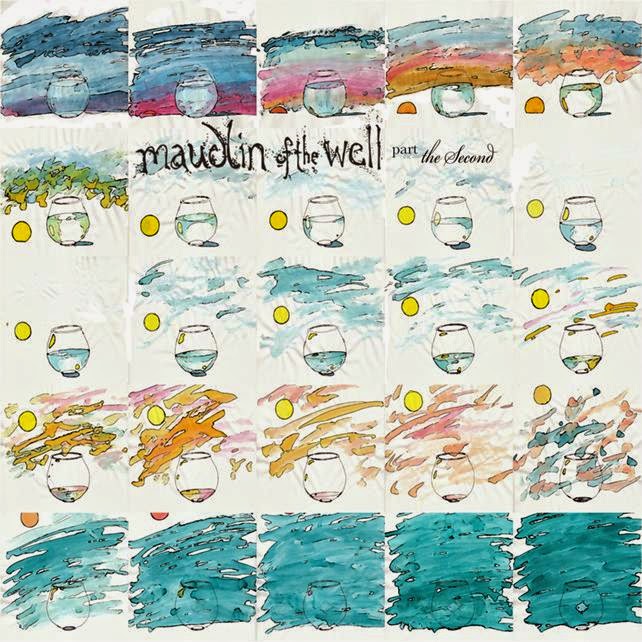
MAUDLIN OF THE WELL - Part The Second

Maudlin farewell

As it is my 100th review on MMA, I shall celebrate by writing a really long, lousy review, freed of my usual hasty formula or any stylistic restraints. You will be bored, moved and bored again. Your time will be wasted with the only consolation being that I wasted even more of it myself. Let's do this thing!... as this paragraph is not long enough yet (that wouldn't look good on the main page, would it.) instead of ending it, let me talk succinctly about the final installment in maudlin of the Well discography. That's what we gathered here for after all. Part The Second was fan funded and it's an entirely independent work with artwork conceived by Toby Driver himself. For those who don't know, he's the mastermind behind all motW and Kayo Dot albums, as well as co-creator/co-founder of Tartar Lamb, Vaura and several other projects. He's a genius, what can I say. Along with Mories of Gnaw Their Tongues, he's my favourite avant rock composer. Speaking of avant rock, I've just realized my 100th review on a metal site is actually of a non-metal album!

Anyway, let's talk maths here. Part the second... but how? In half? Only two parts? Five? Or maybe, judging by the artwork, time is relative, and there's no substantial difference between one second and one day. These are just fragments of the same substance which is apparently infinite. If not for us and our limited perception, there wouldn't be any fragments at all as you can't see contours of seconds, minutes, hours ticking on the clock or years, decades, centuries gradually turning your body into atomic dust. Time's abstract. Yet still we managed to part it, rationalize it. Even though this album looks like it was conceived rationally and divided into 5 tracks, it's not. It's art and art hates rational thinking. Art is based on intuition and driven by feelings. Sounds pretentious? Well, we could certainly have a healthy discussion about what is art, what isn't or if it even is a real thing at all. I'm divided. It seems not to be a real thing but when I start to think it is, I consider art to be something that escapes rationalization. For now. Everything can be explained scientifically and surely will, yet for now there still are some gray areas when it comes to psychology and neurology. I'm glad there are. You have to live in a bubble in order to keep your sanity. However small the bubble is, you can't let it pop or you'll fall into a trap of trying to look at yourself from the outside of your own reasoning, which is obviously self-contradictory.

Okay, without going too far into metaphysics, that's what I believe music is for. Not that music, or art in general, has any other purpose than to satisfy the one who makes it. For someone who listens to music, however, it has potential to be a gate into a world where you can understand and feel yourself without falling back on verbal reasoning. Whether music excites you, makes you happy and euphoric or moves you and makes you depressed, that doesn't matter. What matters is that for this brief moment you're free of restraints of your consciousness. I think that's why people often use drugs to "open their third eye", although lucky are those for whom music works like one. As far as I am concerned, some music does. Part the Second does. All that I've written until now was inspired by the album. If your first thought while going through this review was "This guy's high as fuck", then Part the Second really works. I'm sure some of you would gladly see more substantial commentary on the album, though. Here you go. Part the Second, as any abstract work of art, is a grower. I didn't fall in love with it instantly but my subconscious had already known I would have listened to it again. We tend to call it "getting hooked", intrigued by something for vague reasons. That's because you're not yet aware of something your brain already knows.

In terms of influences, it's the most seamless album by maudlin of the Well and Toby Driver in general. Maybe it's just me, but I can't name more than one influence without hesitation. The album surely is inspired by chamber music. Its structure could just as well be described as progressive/postmodern in a broad sense, but chamber music seems more precise to me due to a prominent role of violin passages. On the other hand, it plays with pacing and repetition in a similar way post-rock does. Luckily, you won't experience any straightforward, full-on build-ups that plague post-rock music nowadays. Part the Second is more sophisticated than that and for that reason it may appear as less accessible to some people. Still, to those accustomed to avant-garde complexity, this will be a refreshing experience. Part the Second doesn't do anything superfluous. It's just as complex as it has to be and never gets heavier than it should. What I say may seem quite vague, but this record really sounds as if it were aware of itself. Every sound, every word is there for a reason and for no reason at all. "This guy's higher than I thought". Well, hear me out, please! I believe that the more brilliant the work you create is, the more difficult it is to explain the choices you made. It's called talent. And talent is an unpredictable asshole.

Oh man, I'm fed up with this review so much right now. Nobody's going to read something that long anyway, so why bother? Most certainly because I felt like 100th review was a good occasion to do something different. Part the Second is one of those albums I couldn't review in a decent way, anyway. It's an album that gets to you on a very personal level, almost as if it were addressed directly to you. As if you were the only one to ever listen to it. The world is abstract after all, so maybe you are the only one listening to it? Maybe all is just an illusion? Or not even that. Maybe the bubble you're trying to preserve is all you actually have? Whatever the case, the final effort by maudlin of the Well is a reminder that music... is a drug! Haha, good one, ain't it?! You didn't see that coming, huh? Please, if you enjoy experimental music of any sorts, listen to Part the Second and get high from the experience. But secretly! Seriously people! Music's gonna be banned if someone from Da Guverment reads this review. I have to go, spec ops are at the door already!... [beep beep beep]

Saturday, October 18, 2014

KAYO DOT - Coffins On Io

Stellar!

Imagine a silver string stretched out across the room. Every of its seven segments is decked with objects of such a variety in shape, size, weight and colour, that they almost seem to be a random streak of elements, suspended magically in space. You can barely see what's linking them all. Yet every time Toby Driver and his ever changing team puts out an album, you instantly recognize who pulls that string. While Hubardo could be, as a last resort, described as a summary of all things Kayo Dot-ish, maudlin-ish and Driver-ish in general, Coffins on Io, just like Coyote before it, is a venture into new territories. 

However, while Coyote treads a bumpy path of chamber disharmony, Coffins on Io, instead of treading a path on foot, drives a Mustang '67 convertible along a desolate highway with southern lights in the night sky above. Every Kayo Dot album features a conceptual basis that provides the whole thing with a core. Even Hubardo was strangely consistent despite its eclecticism. Coffins on Io on the other hand is a rather focused effort... for this band. It is indeed an album heavily inspired by retro-futuro artists of the 80s, Vangelis to name just one. Equally noticeable is David Bowie's influence, especially thanks to Toby Driver's charismatic vocal delivery. You can also get some Joy Division vibes, especially in the second track. Brian Ferry also comes to mind. Generally speaking, songwriting is more minimal compared to the previous album and more focused on subtle evolution through repetition of themes. All that gives the album a quite psychedelic character. Still, somehow Kayo Dot once again escapes categorization and despite more traceable influences than ever before, it's still a band one of its kind.

Coffins on Io charms the listener with dreamy psychedelia and retro pop touches, but as any other Kayo Dot album it requires more than just your attention - it requires you to discover and feel the creative passion that boils just like the magma underneath the surface of Io. As your perception of the music evolves with time, the album does so as well, and before you know it, you're submerged in a polyphonic hell. And you know what? If this kind of hell exists, I'm going to sin as much as possible just to get there.

Thursday, October 16, 2014

Coffins on Io, reviews and other astronomical anomalies

Daily Disclaimer: 

You have to know that Io is one of Jupiter's moons and one of the most hell-like places in our solar system, topped only by Venus (not sure about that).  We all know now after all, so no reason to stop you from reading the following mini-essay. Enjoy.

***

I've been listening to the latest album by Kayo Dot for a week now (it was streamed legally before release, no worries), and I must say that it's... great. Review's on the way, what I am about to write here about is not one. Just some thoughts on the album and other stories that concern it to some extent. I hope.

One thing have been bogging me lately. If you went through my first essay about rating works of art, you know that my approach have evolved quite a bit. Or maybe not evolved, I just realized how futile some attempts at being rational were. I realized that saying that "it's good but not perfect" or that "I don't think it's as good as the previous album" doesn't really make sense. And you know what? I love Hubardo, the previous Dot, and I was even tempted to say that I don't think Coffins on Io is as good. But I decided I won't. It's different. And it's genuinely good, like swimming in a remote lake in the middle of the forest with the night sky above. 

I think writing an objective and detailed review with arguments backing every observation with profound knowledge is not, or shouldn't be the goal in itself, yet just one of the means to accomplish something much more important. These days a good reviewer is the one who's impersonal and objective but let's be honest, it's much harder to give yourself on a plate to the reader and then make him follow you with your writing without embarrassing yourself. That's why we don't do it. We don't do it because being emotional is not cool. Before we go any further, I want to say that I don't consider my reviews to be a good example of that approach. I try to follow this path, but I most often fail. I try to let myself go and try to capture the soul of the album apart from describing it with cold blood. Let's face it, though I'm not really that well versed in music and English is still a foreign language to me. I'm also pretentious which can potentially be repelling for some readers.

I remember reading a review by one of our most prominent reviewers on Metal Music Archives, a review of Gnaw Their Tongues' debut. I loved how in this particular review he crossed the line, broke the fourth wall and spoke for himself, exposed the thoughts that the album evoked in him. That leads me to an obvious observation that you don't have to be that deeply open every time, just don't stop yourself when you feel something. It makes of your review a work of art in itself, and there's nothing better than that.

Tuesday, October 14, 2014

Music, books and how to make them whole

Before I start, a disclaimer:

You have to be a reader and a listener in order to understand the following text. Please do not read if you can't (duh) and/or if you don't listen to music. In addition, kill yourself. No joke.

***

Music. One word, countless feelings evoked. Ah, yes, so you came here to read something written by this guy that tries soooo hard. Here you go. Today's essay's about emotional/conceptual associations we make between books and music we listen to at the moment of reading. Most of it is just me rambling pointlessly, though.

The first time it happened to me was a long time before puberty. I think I was 5 - 8 years old at the time. I had a Disney book called "Hercules" and it was nice and shiny and colorful. It told a disturbing story of a ginger muscle guy and his anorectic girlfriend or whatever. Good stuff. Anyway, somehow I ended up listening to an M people cassette while reading the book. And even now, many years later, I still "feel the feel" of the book every time I listen to M people... which is never by the way, I don't listen to that crap anymore! So, I used to feel it, every time I listened to M people. And I still do whenever they pop up on the radio. It's just as if the music were a soundtrack to the story, regardless of how incompatible M People and Hercules might seem.

Another, maybe even sillier example, is Bjork's "Isobel", a track from Post. As an avid prehistory fan, I read many books about dinosaurs throughout my childhood. I knew "all there was to know" about these creatures. I was obsessed to the point where I saw them among the trees while looking through the car window, hell, I even used to walk around the house, pretending to be one! None of this is made up, I swear! So, anyway, I used to listen to Bjork quite a lot at the time, still do. And "Isobel" has become that one track I instantly associated with dinosaurs. In my infinite naivety, I actually thought it was ABOUT dinosaurs, running through the forest, majestically raising their heads above the treetops. How disappointed I was when I found out, many years later, what the track's name was (yeah, as a kid I didn't care much about titles) and what's more, that it's absolutely NOT about dinosaurs. I still love the song, though.

We tend to forget a lot of the good stuff we learned as kids, and only a few years ago did I realize that I could actually enhance my reading experience by listening to one album over and over again while going through a book. It creates a bond, it makes every book even more of your own, personal experience. Obviously it can't be just any album but rather one that you already know pretty well and like quite a lot. For instance, I've just read Murakami's Hard-boiled Wonderland and The End of the World, one of his most surreal books. Given how I had an awesome experience with Reisefieber by Mikołaj Łoziński combined with One Armed Bandit by Jaga Jazzist, I started to do this book-to-music thing on a regular basis. If it worked, I had this book "stuck" in the music for the rest of my life. If it didn't, well, I'd change the music or settle for silence. So, anyway, I listened to Kayo Dot's Coffins on Io while reading Murakami. And let me tell you, it worked great. Both the book and the album are amazing but they're even better as a duo. Kayo Dot gives you a sense of wonder, menace and psychedelia and that's exactly what you need to amplify the distorted, dreamy mood of Hard-boiled Wonderland.

I know it might not be the most groundbreaking thing and some of you have already tried this. Still, if you haven't, give it a shot: pick an album you like, album you think would go well with the book you're reading and give it a try. Bind the album to the book and keep it this way forever.


Saturday, September 27, 2014

CLOAK OF ALTERING - Plague Beasts

Altering Forever

True artists are restless, insatiable, always looking for modes of expression that would satisfy nobody else but themselves. Not us, mind you. You're just a guest, a spectator of this eternal struggle between artist and his creation. Ahhh, and Mories. Those who came across this man know exactly how unwelcoming he can be. Plague Beasts, third full-length record under the aegis of Cloak of Altering, is another experimental record that catches Mories fusing his diverse styles into one whole. And as usual, it's very well done.

Not as well as it used to be, though. Two previous records presented Cloak of Altering as a well blended combination of black metal, industrial electronica, classical and noise. Plague Beasts consists of pretty much the same ingredients, with a stronger emphasis put on electronic and noise aspects of the music. If you're familiar with the band and its black metal roots are known to you, you can easily trace them. It may not be so obvious to newcomers, though. For the most part Mories' songwriting is as strong as ever. Unrelenting, polyphonic assault of devilish tremolos, ominous symphonic synthesizers and seemingly chaotic syncopation suck you into a whirlwind of beautiful insanity. You can actually see the genuine passion put into this music as it bleeds out of your ears. Still, as much as I hate track-by-track approach, I have to say "Ash666urA" and "Into Celestial Hell", due to their more straightforwardly noisy character, feel a little uninspired in comparison with the rest of the album.

Plague Beasts is another step in CoA's exploration of the unique blend of avant-garde black metal and electronica known from previous releases. While it's easier to mark out individual sound elements this time round, it still is a strangely consistent, yet in parts flawed, record. Recommendable to metal and electronica fans with a weakness for a full-on approach, Cloak Altering latest album is another quality release from the enfant terrible of experimental underground.

Monday, September 9, 2013

KAYO DOT - Hubardo


A lonely Poet and the Eye of Leviathan

Are you proud of yourself, Toby Driver? Are you satisfied with having me as your eternal and devoted follower, speechless in the face of Hubardo's grandeur? If these questions were ever to reach Toby, I imagine the answer to them as follows: "Yes, we did it, we have transmuted the gleaming stone that fell from the moonless sky. Essence and forms blossomed beautifully from the eye of Leviathan and merged into this ever morphing sculpture of sounds. You can almost see it once you close your eyes, open your heart and let the ear follow the chisel."

In a way, Hubardo encompasses everything that Toby Driver has ever done with maudlin of the Well, Kayo Dot and Tartar Lamb, but in fact it is so much more. It's an individual, conceptual work and while it obviously sounds like something made by Kayo Dot, it is more adventurous, dense and technical than anything they've done before. To be completely honest, it's impossible to describe an album with total playing time of almost 100 minutes, that flows like a poem and stirs the soul with whole range of emotions. A record that stupefies with passionate outbursts of experimental extremity, seamlessly evolving into haunting chamber rock passages or krautrock psychedelia. I can't even fathom out how avant-garde jazz and fusion, chamber post-rock, experimental black metal and psychedelic rock can be so beautifully blended together and yet stay so consistent. More than that, Hubardo reaches and goes beyond any horizons; it crushes boundaries and escapes any classification except for one: Art that comes to existence out of pure need of creation itself; need to channel the ephemeral creative fire into an immortal work. And, as if that weren't enough, the album boasts some of the most intriguing ambiance and lyrics I've ever encountered. Ah, so much could be said about this surreal, otherworldly atmosphere and creative freedom. Freedom so moving and spontaneous, despite the staggering complexity of the music it gave birth to.

Hubardo, the seventh album by the avant-chamber-rock/experimental metal band Kayo Dot, is the ultimate evidence that music is boundless. It's one of those rare pieces of art that are so unique and passion driven, that any attempt to analyze and deconstruct it backfires on the reviewer. Even though you may stay indifferent to the beauty of Hubardo, you can't deny its singularity and sheer compositional genius of Kayo Dot. As far as I am concerned, I'm so deep in love with this wondrous album, that I feel ashamed by the very fact of publishing this review. A review that will not do Hubardo enough justice.

Friday, September 6, 2013

DISTORTED HARMONY - Utopia


Six pieces of noble cheese

Traditional progressive metal is often considered to be cheesy, stagnant and derivative. Let's see... "traditional" and "progressive". Not a very fortunate choice of words. Isn't the first one an antonym of the other one? Well, it is, usually. Distorted Harmony managed to bend the rules of semantics though. UTOPIA is dripping with traditional prog metal elements - keyboards, synths and virtuosity. All this, however, is just a wrapping for some really well-crafted, inventive and emotionally charged metal music.

As usual, production is not without significance. What often bothers me about modern prog releases, is that the sound feels overproduced and artificial. Fortunately, UTOPIA's sound is indeed polished yet infused with a healthy dose of organic sharpness and spiced with a pinch of old-school prog rock softness. As a result, all assets of the album - intricate passages, theme changes with underlying symphonic prog basis - are well highlighted.

"Apparently Michael Bublé wouldn't be so dull if he stopped rehashing ideas of Frank Sinatra and started a prog metal band." That's what I thought right after hearing Misha Soukhinin's voice in "Kono Yume". His vocals are one of the best things about Distorted Harmony, no joke! Expressive, well trained and original. Especially when compared to typical prog metal vocalists, trying to sound like James LaBrie or Geoff Tate. Misha's voice reminds me of Michael Bublé (darn, I feel like I shouldn't be saying this) and his timbre suits the music very well. As for the music, UTOPIA consists of six intricate compositions, deeply rooted in classic progressive metal and underlaid with strong symphonic prog rock element. All that tinged with Opeth's eclectic approach to harmony and... some pop catchiness. At times I feel like some of the cheesy parts could have been avoided but as a whole, UTOPIA is a top-notch progressive metal release.

I'm not by any means a fan of traditional progressive metal. I don't like Dream Theater and Queensrÿche get on my nerves. Still, I really like this album. So, even if you're not into this sub-genre of metal music, give Distorted Harmony a chance to, ermm... distort your tastes... clumsy pun, eh?