Showing posts with label avant-rock. Show all posts

Monday, July 25, 2016

KAYO DOT - Plastic House On Base Of Sky

Revisiting the uncharted 

This review opens with a title that some of the more perceptive readers would deem absurd and some of the more radical ones, stupid. And yet, the very existence of postmodernism is dependent on how good we are at reshaping the old into the new. Making it as refreshing and intriguing as it was when it first came into being. More important still, is the ability of postmodern art to go beyond this premise, set itself in a world of its own and exist there on its own terms. And who else would I ever believe capable of creating an entire world for their music to exist in, if not Toby Driver. Ever since Choirs of the Eye (and for some, early maudlin of the Well), Toby's musical identity has been shining through layers of inspiration and styles he has explored. None of what he did has ever seemed either derivative, calculated or entirely spontaneous and the fact I don't really understand how or why he does what he does made me wonder - is it part of the fun? Yes, it actually is a big chunk of it - admiring someone's brilliance while being blinded by it.

It's obvious that Toby has decided to create more focused, more compact albums after Hubardo, arguably the most diverse and, without a doubt, the longest album in his career. Unlike pre-Hubardo records, both Coffins on Io and Plastic House on Base of Sky feature a somewhat vintage sound. Strongly inspired by Susumu Hirasawa and by the 80s icons, with the most prominent being David Bowie, Joy Division, Brian Ferry, Vangelis and the whole era of progressive rock and electronica, Toby does what he does best - he dislocates all elements from their hinges, makes them his own, unique - they are doors to his plastic house. It's especially true on the new record where the border between organic and synthetic became completely blurred. As radical as ever, Kayo Dot takes no prisoners despite leaving their extreme rock roots behind. Plastic House on Base of Sky is a playground for electronic polyphony, unrelenting, rhythmically complex and intense but as usual, a profound feeling of purpose grows stronger with every subsequent spin. This is one of those records that interact with the listener on the most personal level possible, mostly because the artistic process itself knew no compromise. That's why reviewing Kayo Dot albums is so daunting - the band doesn't try to prove anything to anyone. Toby seems to be lost in a maelstrom of creativity and despite fiercely pushing the envelope, he never loses track of what makes Kayo Dot music so engaging: the unrefined, frantically honest emotional charge put into it.

The latest Kayo Dot release catches Toby Driver drifting further and further away from his extreme rock roots, deep into the unknown where the old merges with the new to become something, somewhere. To be honest, it has never mattered to me if it's metal or not. Despite being extreme in a general sense, Kayo Dot was never meant to appeal to metal fans or fans of any other specific genre. I honestly don't know who is this music addressed to, and I doubt it is actually addressed to anyone in particular. All I can say is that you should approach the album with an open mind and forget what you know about art-rock, jazz, progressive electronica or synth-pop. Plastic House on Base of Sky is neither of those things. It is more.

Saturday, April 25, 2015

KAYO DOT - Gamma Knife

He could not remember the dream

Gamma Knife cuts through his skull as soon as he falls asleep. His vision is dim and blurred at first but it brightens with every second and he feels moved by the blissful, eerie spectacle that unfolds before him. The knife suddenly reaches his mind and the bubble bursts. All becomes vivid as the chaos spreads around and all calmness drowns in its foaming depths. How long did it last? Can time be measured in a place like this? He doesn't know. But as the edge of radiation withdraws, he is in a peaceful place again. Soft light soothes his senses as sounds of music sustain his slumber. And it all ends with silence... Now that I lost most of you with my failed attempt at artistic writing, let's begin. 

As by far the most obscure album by Kayo Dot, Gamma Knife is a negative of itself. An amazing case of an album that contradicts itself and yet, by the power of its overarching idea, works wonderfully as a whole. Now, if I just came down to earth for a moment... Gamma Knife is intentionally made that way to create an impact. The album begins and ends with stunningly beautiful and soothing, choral chamber music recorded in studio, but at its core are three tracks recorded live in concert. Could it go any weirder? Well, yes! In short, the middle part is as eclectic, avant-garde and extreme as it could get in less than twenty minutes. It's basically like a surreal 20s film where avant-chamber music meets jazz, RIO and black metal and have a shot of absinthe. The black metal side is somewhat reminiscent of Deathspell Omega and early maudlin of the Well. Compared to other avant metal acts like Ephel Duath, Gamma Knife sounds much more organic and bold in its exploration of avant jazz and chamber music. Strong psychedelic presence in the vein of Swans is also noticeable. However, what binds all these elements together to give them common identity, is the unmistakable Kayo Dot vibe that, like a totem spirit, animates every single album by this band. 

I must admit that at first Gamma Knife didn't work for me as well as it does today, and I did not fully embrace its inner dualism until just a few months ago. Just like any other album by Kayo Dot, it's definitely not an easy one to get into but it's all the more rewarding once you do. Less focused on patient theme evolution of Choirs of the Eye and more on tight, aggressive experimentation known from Hubardo, Gamma Knife is a truly unique avant-garde rock ride. Let it sink in and you'll have one damn peculiar daydream every time you give it a spin.

Monday, October 20, 2014

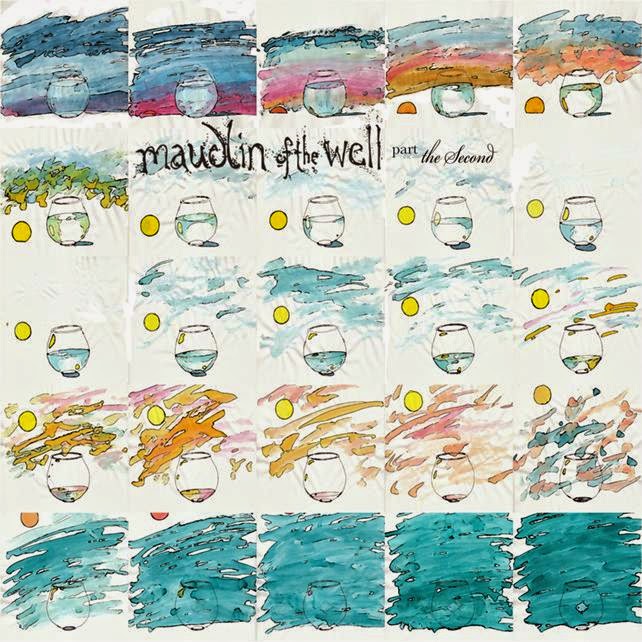
MAUDLIN OF THE WELL - Part The Second

Maudlin farewell

As it is my 100th review on MMA, I shall celebrate by writing a really long, lousy review, freed of my usual hasty formula or any stylistic restraints. You will be bored, moved and bored again. Your time will be wasted with the only consolation being that I wasted even more of it myself. Let's do this thing!... as this paragraph is not long enough yet (that wouldn't look good on the main page, would it.) instead of ending it, let me talk succinctly about the final installment in maudlin of the Well discography. That's what we gathered here for after all. Part The Second was fan funded and it's an entirely independent work with artwork conceived by Toby Driver himself. For those who don't know, he's the mastermind behind all motW and Kayo Dot albums, as well as co-creator/co-founder of Tartar Lamb, Vaura and several other projects. He's a genius, what can I say. Along with Mories of Gnaw Their Tongues, he's my favourite avant rock composer. Speaking of avant rock, I've just realized my 100th review on a metal site is actually of a non-metal album!

Anyway, let's talk maths here. Part the second... but how? In half? Only two parts? Five? Or maybe, judging by the artwork, time is relative, and there's no substantial difference between one second and one day. These are just fragments of the same substance which is apparently infinite. If not for us and our limited perception, there wouldn't be any fragments at all as you can't see contours of seconds, minutes, hours ticking on the clock or years, decades, centuries gradually turning your body into atomic dust. Time's abstract. Yet still we managed to part it, rationalize it. Even though this album looks like it was conceived rationally and divided into 5 tracks, it's not. It's art and art hates rational thinking. Art is based on intuition and driven by feelings. Sounds pretentious? Well, we could certainly have a healthy discussion about what is art, what isn't or if it even is a real thing at all. I'm divided. It seems not to be a real thing but when I start to think it is, I consider art to be something that escapes rationalization. For now. Everything can be explained scientifically and surely will, yet for now there still are some gray areas when it comes to psychology and neurology. I'm glad there are. You have to live in a bubble in order to keep your sanity. However small the bubble is, you can't let it pop or you'll fall into a trap of trying to look at yourself from the outside of your own reasoning, which is obviously self-contradictory.

Okay, without going too far into metaphysics, that's what I believe music is for. Not that music, or art in general, has any other purpose than to satisfy the one who makes it. For someone who listens to music, however, it has potential to be a gate into a world where you can understand and feel yourself without falling back on verbal reasoning. Whether music excites you, makes you happy and euphoric or moves you and makes you depressed, that doesn't matter. What matters is that for this brief moment you're free of restraints of your consciousness. I think that's why people often use drugs to "open their third eye", although lucky are those for whom music works like one. As far as I am concerned, some music does. Part the Second does. All that I've written until now was inspired by the album. If your first thought while going through this review was "This guy's high as fuck", then Part the Second really works. I'm sure some of you would gladly see more substantial commentary on the album, though. Here you go. Part the Second, as any abstract work of art, is a grower. I didn't fall in love with it instantly but my subconscious had already known I would have listened to it again. We tend to call it "getting hooked", intrigued by something for vague reasons. That's because you're not yet aware of something your brain already knows.

In terms of influences, it's the most seamless album by maudlin of the Well and Toby Driver in general. Maybe it's just me, but I can't name more than one influence without hesitation. The album surely is inspired by chamber music. Its structure could just as well be described as progressive/postmodern in a broad sense, but chamber music seems more precise to me due to a prominent role of violin passages. On the other hand, it plays with pacing and repetition in a similar way post-rock does. Luckily, you won't experience any straightforward, full-on build-ups that plague post-rock music nowadays. Part the Second is more sophisticated than that and for that reason it may appear as less accessible to some people. Still, to those accustomed to avant-garde complexity, this will be a refreshing experience. Part the Second doesn't do anything superfluous. It's just as complex as it has to be and never gets heavier than it should. What I say may seem quite vague, but this record really sounds as if it were aware of itself. Every sound, every word is there for a reason and for no reason at all. "This guy's higher than I thought". Well, hear me out, please! I believe that the more brilliant the work you create is, the more difficult it is to explain the choices you made. It's called talent. And talent is an unpredictable asshole.

Oh man, I'm fed up with this review so much right now. Nobody's going to read something that long anyway, so why bother? Most certainly because I felt like 100th review was a good occasion to do something different. Part the Second is one of those albums I couldn't review in a decent way, anyway. It's an album that gets to you on a very personal level, almost as if it were addressed directly to you. As if you were the only one to ever listen to it. The world is abstract after all, so maybe you are the only one listening to it? Maybe all is just an illusion? Or not even that. Maybe the bubble you're trying to preserve is all you actually have? Whatever the case, the final effort by maudlin of the Well is a reminder that music... is a drug! Haha, good one, ain't it?! You didn't see that coming, huh? Please, if you enjoy experimental music of any sorts, listen to Part the Second and get high from the experience. But secretly! Seriously people! Music's gonna be banned if someone from Da Guverment reads this review. I have to go, spec ops are at the door already!... [beep beep beep]

Saturday, October 18, 2014

KAYO DOT - Coffins On Io

Stellar!

Imagine a silver string stretched out across the room. Every of its seven segments is decked with objects of such a variety in shape, size, weight and colour, that they almost seem to be a random streak of elements, suspended magically in space. You can barely see what's linking them all. Yet every time Toby Driver and his ever changing team puts out an album, you instantly recognize who pulls that string. While Hubardo could be, as a last resort, described as a summary of all things Kayo Dot-ish, maudlin-ish and Driver-ish in general, Coffins on Io, just like Coyote before it, is a venture into new territories. 

However, while Coyote treads a bumpy path of chamber disharmony, Coffins on Io, instead of treading a path on foot, drives a Mustang '67 convertible along a desolate highway with southern lights in the night sky above. Every Kayo Dot album features a conceptual basis that provides the whole thing with a core. Even Hubardo was strangely consistent despite its eclecticism. Coffins on Io on the other hand is a rather focused effort... for this band. It is indeed an album heavily inspired by retro-futuro artists of the 80s, Vangelis to name just one. Equally noticeable is David Bowie's influence, especially thanks to Toby Driver's charismatic vocal delivery. You can also get some Joy Division vibes, especially in the second track. Brian Ferry also comes to mind. Generally speaking, songwriting is more minimal compared to the previous album and more focused on subtle evolution through repetition of themes. All that gives the album a quite psychedelic character. Still, somehow Kayo Dot once again escapes categorization and despite more traceable influences than ever before, it's still a band one of its kind.

Coffins on Io charms the listener with dreamy psychedelia and retro pop touches, but as any other Kayo Dot album it requires more than just your attention - it requires you to discover and feel the creative passion that boils just like the magma underneath the surface of Io. As your perception of the music evolves with time, the album does so as well, and before you know it, you're submerged in a polyphonic hell. And you know what? If this kind of hell exists, I'm going to sin as much as possible just to get there.

Monday, September 9, 2013

KAYO DOT - Hubardo


A lonely Poet and the Eye of Leviathan

Are you proud of yourself, Toby Driver? Are you satisfied with having me as your eternal and devoted follower, speechless in the face of Hubardo's grandeur? If these questions were ever to reach Toby, I imagine the answer to them as follows: "Yes, we did it, we have transmuted the gleaming stone that fell from the moonless sky. Essence and forms blossomed beautifully from the eye of Leviathan and merged into this ever morphing sculpture of sounds. You can almost see it once you close your eyes, open your heart and let the ear follow the chisel."

In a way, Hubardo encompasses everything that Toby Driver has ever done with maudlin of the Well, Kayo Dot and Tartar Lamb, but in fact it is so much more. It's an individual, conceptual work and while it obviously sounds like something made by Kayo Dot, it is more adventurous, dense and technical than anything they've done before. To be completely honest, it's impossible to describe an album with total playing time of almost 100 minutes, that flows like a poem and stirs the soul with whole range of emotions. A record that stupefies with passionate outbursts of experimental extremity, seamlessly evolving into haunting chamber rock passages or krautrock psychedelia. I can't even fathom out how avant-garde jazz and fusion, chamber post-rock, experimental black metal and psychedelic rock can be so beautifully blended together and yet stay so consistent. More than that, Hubardo reaches and goes beyond any horizons; it crushes boundaries and escapes any classification except for one: Art that comes to existence out of pure need of creation itself; need to channel the ephemeral creative fire into an immortal work. And, as if that weren't enough, the album boasts some of the most intriguing ambiance and lyrics I've ever encountered. Ah, so much could be said about this surreal, otherworldly atmosphere and creative freedom. Freedom so moving and spontaneous, despite the staggering complexity of the music it gave birth to.

Hubardo, the seventh album by the avant-chamber-rock/experimental metal band Kayo Dot, is the ultimate evidence that music is boundless. It's one of those rare pieces of art that are so unique and passion driven, that any attempt to analyze and deconstruct it backfires on the reviewer. Even though you may stay indifferent to the beauty of Hubardo, you can't deny its singularity and sheer compositional genius of Kayo Dot. As far as I am concerned, I'm so deep in love with this wondrous album, that I feel ashamed by the very fact of publishing this review. A review that will not do Hubardo enough justice.